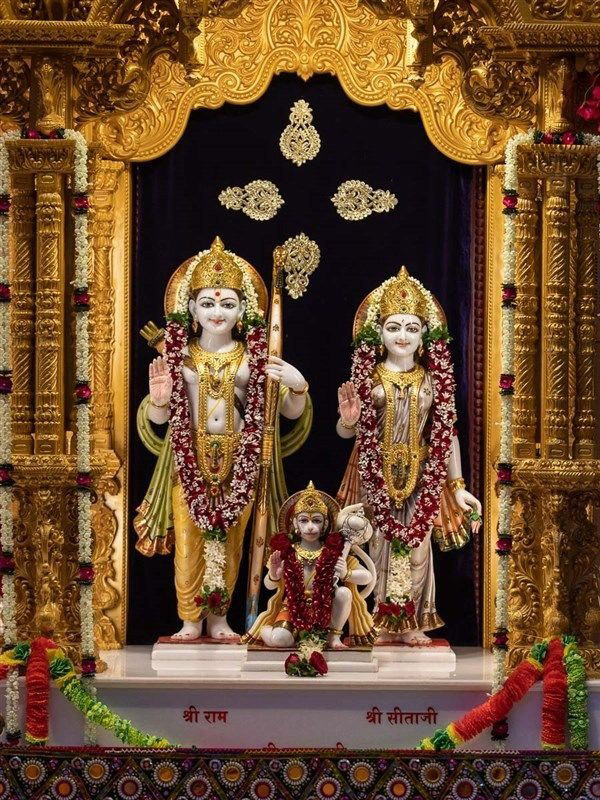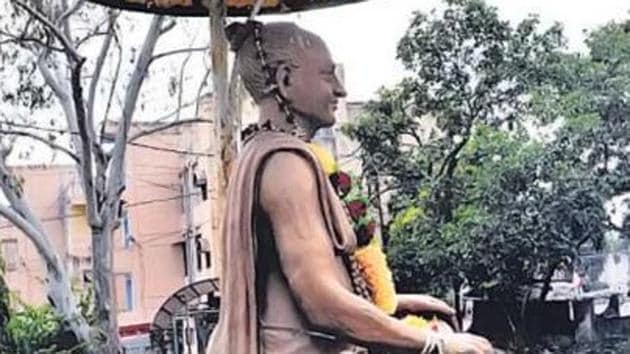


Śrī Hanumān is not merely a hero; he is an ideal, the perfect servant (dāsa), the fearless warrior, the learned sage, and the living bridge between jñāna (wisdom), bhakti (devotion), and śakti (power). The scriptures and saint-poets repeatedly return to Hanumān ji to show what real devotion looks like in action.
He is the Vajrangbali (one with limbs as strong as thunderbolts) and simultaneously the humble Ram-doot (messenger of Ram). He is a masterclass in how immense power is best used when tethered to complete surrender.
In the Hanuman Chalisa, composed by the saint Goswami Tulsidas,
Kanchana barana biraja subesa, kanana kundala kunchita kesa.
Hatha bajra au dhwaja birajai, kandhe moonj janeu saajai.
— Hanuman Chalisa, Verses 4-5
“Your complexion is golden, and you are beautifully dressed with curly hair and earrings. In your hand shine the Thunderbolt (Vajra) and the Victory Flag, while the sacred thread of Munja grass adorns your shoulder.”
Tulsidas ji emphasizes that Hanuman ji isn’t just a physical powerhouse; he is “Vidyavan guni ati chatur” (The possessor of all knowledge, virtuous, and extremely clever).
When Hanuman Ji first meets Shri Ram in the Kishkindha Kand of Valmiki’s Ramayan. Sent by Sugriva to determine the strangers’ intentions, Hanuman approaches Shri Ram and Lakshman ji with eloquent words. After their conversation, Shri Ram says to Lakshman:
“nānṛgvedavinītasya nāyajurvedadhāriṇaḥ | nāsāmavedaviduso śakyam evaṃ vibhāṣitum” (Kishkindha Kanda 3.28)
“One not trained in the Rig Ved, not bearing the Yajur Ved, not knowing the Sam Ved, cannot speak in this manner.”
Shri Ram notes that Hanuman’s speech is free from flaws in pronunciation, grammar, or expression, proving that he is the ultimate scholar (Pandit).
Sa vyakarana-martha-vit sarva-shastra-vidam-varah | — Valmiki Ramayana, Uttar Kanda, 36.45
“He is the master of grammar (Vyakaran) and the foremost among those who know all the Shastras (scriptures).”
He is the patron of the Nava Vyakaran (the nine systems of grammar). His intellect is as vast as his physical strength, reminding us that a sharp, disciplined mind guides true strength.
The Definition of Devotion
The Ramcharitmanas contains one of the most poignant descriptions of Hanuman’s humility. Despite burning Lanka and finding Sita, Hanuman gives all credit to Rama.
So saru saba tava pratap raghurai |
Natha na kachhu mori prabhutai ||
— Ramcharitmanas, Sundar Kand, 32.3
“O Lord of the Raghus, all this is the glory of Your majesty; there is no greatness of my own in it, my Master.”
दासोऽहं कोसलेंद्रस्य
रामस्याक्लिष्टकर्मणः
Dāso’ham Kosalendrasya
Rāmasyākliṣṭa-karmaṇaḥ
“I am the servant of Rāma, the king of Kosala, whose actions are flawless.”
Vālmīki Rāmāyaṇa, Sundara Kāṇḍa 35.10
Identity is not ego; identity is service.
These verses highlight the concept of Nishkam Karm (selfless action).
The Master of Senses (Jitendriya)
Manojavam Maruta-Tulya-Vegam, Jitendriyam Buddhimatam Varishtham |
Vatatmajam Vanara-Yutha-Mukhyam, Shrirama-Dutam Sharanam Prapadye ||
Manojavam: Faster than the mind.
Maruta-Tulya-Vegam: With speed equal to the wind.
Jitendriyam: Master of the senses.
Buddhimatam, Varishtham: Foremost among the learned.
“I take refuge in the messenger of Shri Ram, who is the chief of the Vanara army and the son of the Wind God.”
“yatra yatra raghunāthakīrtanaṃ tatra tatra kṛtamastakāñjalim | bhāṣpavarāri paripūrṇalocanaṃ mārutim namata rākṣasāntakam”
“Wherever the glory of Ram is sung, there with folded hands and eyes filled with tears of joy, stands Maruti (Hanuman), the destroyer of demons.”
Attributes of Hanuman ji
| Attribute | Scriptural Term | Source |
| Speed/Agility | Manojavam | Hanuman Ashtakam |
| Wisdom | Jnani Nam Agraganyam | Ram Raksha Stotra |
| Power | Atulita Bala Dhamam | Ramcharitmanas (Sundar Kand) |
| Service | Ram Kaji Karibe Ko Atur | Hanuman Chalisa |
Hanuman: The Bridge Between Power and Prayer
In the vast landscape of Vedic literature, Hanuman ji stands as the most “complete” character. He is the perfect synthesis of Shakti (power), Bhakti (devotion), and Jnana (wisdom). Hanuman ji embodies all three in their peak form.
The Divine Incarnation: The 11th Rudra
The Shiva Puran explains that Hanuman is not merely a vanara, but an incarnation of Lord Shiva himself.
Asrijat-sa talam vayu-na dwarena mahatmanah | Hanumaniti nanda-khyam shiva-rupam mahabalam || — Shiva Purana, Shatarudra Samhita, 20.3
“Lord Shiva, through the medium of the Wind-god (Vayu), manifested himself in the form of Hanuman, the immensely powerful one, for the sake of assisting Lord Ram.”
This explains why Hanuman is referred to as Rudra-avatar. He represents the “transformative fire” of Shiv directed toward the “preservation” work of Vishnu (Ram).
The Panchamukhi: The Esoteric Five-Faced Protector
In the Sri Vidyarnav Tantra, the secret of Hanuman’s five faces (Panchamukhi) is revealed. This form emerged to kill the demon Mahiravan in the underworld (Patala).
The five faces represent the five directions and five specific boons:
- Hanuman (East): Grants purity of mind and success.
- Narasimha (South): Grants victory and fearlessness.
- Garuda (West): Wards off evil spells, black magic, and poisons.
- Varaha (North): Grants prosperity and removes planetary disturbances.
- Hayagriva (Upward): Grants knowledge and liberation.
Panchasyachuta-maneka-vichitra-varnam Vaktram shashanka-shikharam kapi-raja-varyam | — Panchamukhi Hanuman Stotram, Verse 1
“I salute the five-faced one, who is of diverse colors, whose head reaches the moon, and who is the supreme King of Monkeys.”
The Eight Supernatural Powers (Ashta Siddhi)
In the Hanuman Chalisa, Tulsidas ji mentions a specific blessing given to Hanuman by Mother Sita:
Ashta siddhi nava nidhi ke data, asabar deen janki mata. — Hanuman Chalisa, Verse 31
“You are the bestower of the eight supernatural powers and nine types of wealth, as blessed by Mother Janaki (Sita).”
These Ashta Siddhis include:
- Anima: Ability to become infinitely small (used to enter Lanka).
- Mahima: Ability to become infinitely large (used to burn Lanka).
- Garima: Ability to become infinitely heavy.
- Laghima: Ability to become weightless.
- Prapti: Ability to touch any object or travel anywhere.
- Prakamya: Ability to realize any desire.
- Isitva: Lordship over creation.
- Vasitva: Control over all beings and elements.
The Philosophy of Surrender
The most profound quote regarding Hanuman’s relationship with Shri Ram comes from the Adhyatm Ramayan. When Ram asks Hanuman how he perceives Him, Hanuman ji replies:
देहबुद्ध्या तु दासोऽस्मि जीवबुद्ध्या त्वदंशकः।
आत्मबुद्ध्या त्वमेवाहमिति मे निश्चिता मतिः॥
tu daso’ham, jiva-buddhya tvad-amshakah | Atma-buddhya tvamevaham, iti me nishchita matih ||
- From the standpoint of the body: “I am Your servant.”
- From the standpoint of the individual soul: “I am a part (Amsa) of You.”
- From the standpoint of the Absolute Truth: “I am You.”
This is Advaita, Viśiṣṭādvaita, and Dvaita reconciled, through devotion.
Every one of these experiences and perspectives on the Divine is correct in its own right, and a true seeker and Bhakt can be blessed to have the opportunity to experience all forms of Divinity!
The Eternal Guardian (Chiranjeevi)
Unlike other avatars who leave the earth, Hanuman ji is granted a stay until the end of the current epoch. In the Ramayan, Lord Ram grants him this boon:
Yavat-rama-katha-loke, pracharishyati pavane | Tavat-sthasyasi medinyam, mat-katha-mapracharayan || — Valmiki Ramayana, Uttara Kanda, 40.16
“As long as the story of Ram (Ramakatha) is told in the world, O son of the Wind, so long shall you remain on this earth, keeping My story alive.”
This makes Hanuman ji even closer. It is believed that if you read the Ramayan with deep devotion, a guest will always be present in the room; that invisible listener is Hanuman.
Kavan so kaaj kathin jag mahi | Jo nahi hoi taat tumha pahi || — Ramcharitmanas, Kishkindha Kand, 30.6
“What task is there in this world, however difficult, that cannot be accomplished by you, O dear one?”
“श्री रामदूतम शरणं प्रपद्ये” (Shree Raamaduutam sharanam prapadhye)
“I take refuge at the feet of the messenger of Lord Rama (Hanuman).”